

 +86 15268683708



News




0102030405
Coffee and pepper grinders
Coffee Grinder Cleaning Design and Maintenance Access
2026-10-27
Cleaning is almost never the first line of a coffee grinder inquiry, yet it is one of the first things a distributor hears about once a container lands and the units reach end users. Burr geometry, motor power and grind consistency win the order; cleaning design decides whether the second order happens. For importers and private label brands running a program that spans electric coffee grinders, spice grinders, milk frothers and portable juicer cups, cleanability is not a cosmetic detail. It is a measurable design property that can be specified on a drawing, verified during sampling, and written into a purchase contract.
Coffee Grinder Cleaning Design and Maintenance Access
This article approaches the coffee grinder as a machine that must be taken apart, wiped, dried and put back together hundreds of times over its service life. The focus is deliberately practical: how the product is disassembled, where grounds accumulate, how fine dust travels toward the motor, what the manual must say, and which parameters a buyer should freeze before tooling is approved. It is written for sourcing teams, product managers and quality engineers who need to turn the vague request "make it easy to clean" into enforceable requirements.
Why Cleaning Access Belongs in the Technical Specification
Most warranty conversations about grinders start with a complaint that sounds like a performance failure: the grinder is slower, the coffee tastes stale, the machine smells, or the motor stopped. In a significant share of those cases the root cause is accumulated grounds, moisture introduced during cleaning, or a user who could not reach the grind chamber and gave up. When cleaning access is poor, the end user either stops cleaning or cleans incorrectly, and both outcomes end at the same place: a return, a bad review, or a service claim that the brand absorbs.
The commercial consequence is not limited to the grinder SKU. A buyer who sources a coordinated range of countertop appliances, from burr grinders to spice mills to milk frothers, inherits the same cleaning ergonomics across every category. Standardizing on a platform where the grinding or whisking assembly can be removed without tools simplifies the manual, the spare parts list, the customer service script and the aftermarket kit. Standardizing on a platform that requires a screwdriver and a service video does the opposite.
Disassembly Architecture: Tool-Free, Bayonet and Screw-Fixed Designs
The first question to put on a specification sheet is deceptively simple: which parts of the grind path can the end user remove, and with what? A well-designed consumer or light commercial grinder typically separates into a hopper, an upper burr carrier, a lower burr or burr seat, a grind chamber and a grounds container. The question is whether each of those separates by hand, by a quarter-turn bayonet, or by a fastener that requires a tool.
Tool-free and bayonet interfaces are generally preferred for consumer and gift-channel products. A quarter-turn bayonet gives the user an audible and tactile confirmation that the part is seated, which reduces the risk of reassembly error and the resulting complaints about noise or misalignment. Bayonet designs do need attention to wear: repeated cycles over a multi-year life can loosen the ramp, so the drawings should call out the material, the wall thickness at the locking ramps and the number of cycles the interface must survive. A screw-fixed assembly is more rigid and is common on higher-output units, but it shifts maintenance from the user to the service network, which changes the spare parts strategy entirely.
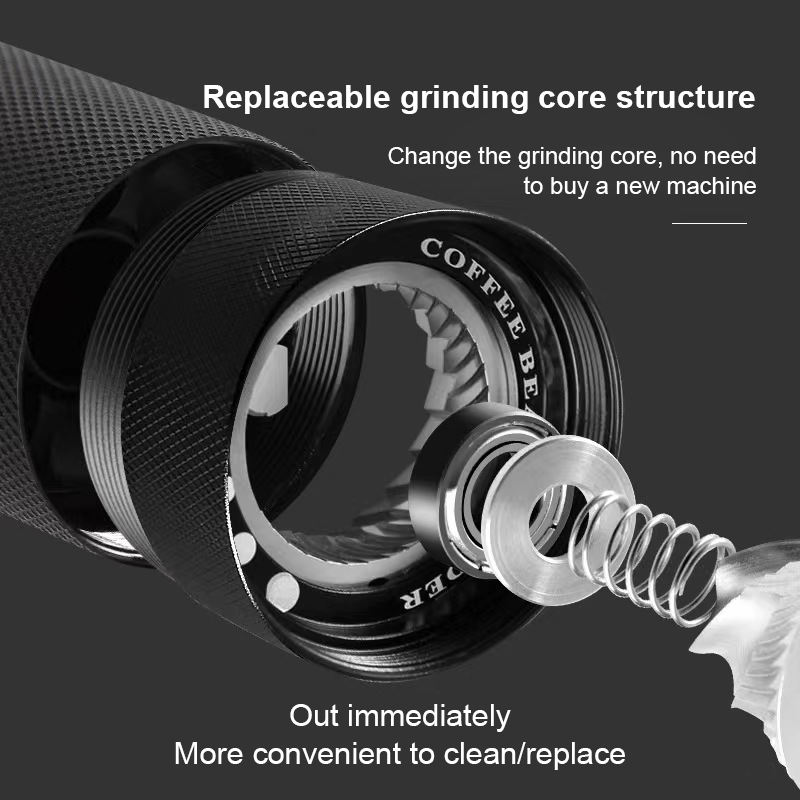
A third consideration is spare-part modularity. If the burr set, the chamber and the hopper are designed as separately orderable assemblies with their own part numbers, a damaged or heavily stained chamber can be replaced instead of the whole appliance. That single decision converts a potential full-unit return into a low-cost parts shipment. When evaluating a candidate design, ask the factory to provide an exploded view with part numbers for exactly the items that touch coffee.
Retention, Static Charge and the Dead Corners of the Grind Chamber
Grind retention is usually discussed as a flavor issue, but for a sourcing team it is equally a cleaning issue. Every gram of grounds left behind in the chamber after a cycle becomes stale, absorbs ambient moisture, and eventually transfers into the next dose. In a household that grinds dark, oily beans in the morning and a light roast on the weekend, that transfer is what the customer describes as "the coffee tastes off" or "the grinder smells rancid". The design variables that drive retention are the volume of the discharge path, the slope of the chamber floor, the surface finish of the internal walls, and whether there are ledges, screw heads or seams where fines can settle.
Grounds retention is therefore a parameter to be measured and frozen, not a marketing talking point. Static charge makes retention worse by making fines cling to vertical surfaces and to the outside of the grounds bin. Mitigation is a system property rather than a single part: material selection and surface finish of the chamber, grounding paths where the design allows it, the geometry of the discharge chute, and in some platforms a controlled amount of moisture at the bean stage. Buyers should not ask for an abstract "anti-static" claim. They should ask where fines accumulate in the current tool, and whether a change to the chamber draft angle or surface texture would reduce it.
Every program should also settle the question of cleaning accessories early. A brush with a stiff, heat-resistant head and a handle long enough to reach the bottom of the chamber costs very little at the unit level and prevents the most common complaint of all: fines packed under the lower burr that the user can see but cannot reach. Some brands also specify a portion of grinder-cleaning pellets or a sample of cleaning beans in the gift-box configuration, which is a low-cost way to make retention visible and manageable from the first use.
Moisture, Mold Risk and Verification of Food-Contact Surfaces
Water is the enemy of a grind chamber. Grounds plus humidity form a paste that adheres to burrs and corners, and in a warm kitchen that paste can support mold growth within a short period. The design response is to make drying easy and to make the mistake hard. Removable chambers with a wide opening dry faster than fixed chambers accessed through a narrow throat. Chamber geometry with rounded internal corners dries faster than sharp corners that hold a film of moisture. Any part that can be removed should be safe to wash and, ideally, shaped so that it drains and dries when left upside down on a rack.
On the compliance side, do not treat cleaning as a separate topic from material compliance. The surfaces that the user is instructed to wash are food-contact surfaces, and the finishes, coatings and lubricants used on or near them must be declared and supported by the supplier's material documentation. Ask which internal surfaces are coated, what the coating is, what the substrate is, and whether the coating is rated for repeated contact with warm water and mild detergent. If a lubricant is used on a bearing or a gear near the grind path, confirm that it is a food-grade grade and that there is a physical barrier preventing migration. Where the unit will be sold into a market with its own food-contact regime, the declarations must cover the specific materials in the specific configuration being shipped, not a generic family certificate.
Verification is straightforward and should be built into the approval process. Request material declarations for every part in the grind path, a list of surface treatments, and confirmation that cleaning agents named in the manual do not attack the stated materials. Then confirm it physically during sampling: wash, dry and reassemble the unit repeatedly using only the method described in the manual, and inspect for coating lift, clouding, corrosion or odor retention.
Sealing the Drive Train: Dust Paths, Carbon Brushes and Brushless Motors
Fine coffee dust travels. The paths are predictable: along the output shaft, through the gap between the chamber and the housing, through the adjustment collar of a stepped or stepless grind selector, and through any opening left for cooling air. Once dust reaches the motor it acts as an abrasive, which is why the dust ingress path deserves a line item in the design review, and it also creates a combustible, heat-retaining layer around the windings. This is why the interface between the grind chamber and the drive train deserves specific attention in the design review, including shaft seals, labyrinth features in the housing joint, and the felt or foam gaskets that are easy to value-engineer away and expensive to lose.
Motor type changes the maintenance profile. A brushed universal motor is inexpensive and delivers high speed, but the brushes are a consumable item and carbon dust adds to the debris inside the housing. If a program specifies a brushed motor, the maintenance plan should address whether brushes are accessible for replacement, whether the holder can be reached without destroying the housing, and whether the brush grade is documented for consistent service life. A brushless motor removes brush wear from the equation and generally produces less internal debris, which reduces cleaning-driven service events, at a higher component cost and with more complex electronics. The right answer depends on the channel: a travel-retail portable grinder and a countertop home grinder rarely justify the same motor architecture.
Whichever architecture is chosen, the buyer should ask the factory to identify the sealing features on the drawing and to explain what happens to them over time. Gaskets compress, felt dries out, and a labyrinth that works when new may allow dust migration after thermal cycling. A short statement of which seals are serviceable, and which require returning the unit, is a legitimate item for the specification freeze.
Cleaning Guidance as a Warranty-Cost Control Tool
The instruction manual is the cheapest warranty-reduction tool a brand owns, and the cleaning chapter is the most consequential part of it. A customer who cannot figure out how to open the chamber will either force it or stop cleaning. A customer who rinses a housing under a tap will create an electrical fault that looks like a product defect. A customer who puts a removable chamber in a dishwasher when the material is not rated for it will generate a warped part and a claim. None of those outcomes require an engineering change to prevent; they require one clear page in the booklet.
The commercial logic is simple. Returns consume freight, inspection labor, replacement stock and customer goodwill. Negative reviews that describe a product as hard to clean suppress conversion for every future buyer, including the ones whose units would have been fine. Time spent on the cleaning chapter is therefore not a documentation cost, it is a cost-avoidance measure that scales with volume. This is also where a supplier with experience across multiple categories can help: a factory that builds grinders, spice mills, frothers and portable blenders has seen which cleaning instructions generate the fewest service tickets and can share that pattern without inventing numbers.
Tip: before locking artwork, have someone who has never seen the product follow only the printed cleaning steps, start to finish, without asking questions. Every hesitation becomes an illustration, a callout, or a redesign request.
What the Cleaning Chapter Must Contain
- A frequency table expressed in usage terms rather than calendar terms: after every oily-bean session, weekly for the chamber, monthly for a deep clean of the burr area, and immediately after any spill or moisture ingress.
- The exact disassembly sequence with part names matching the exploded diagram, including the direction of any bayonet rotation and the torque feel of a screw-fixed carrier.
- An explicit prohibited-methods list: no water on the motor housing or base, no immersion of any part containing electronics or a bearing assembly, no dishwasher unless the specific part material is rated for it, no compressed household air cans used at close range, and no metal implements against burr edges.
- A drying requirement with a realistic method and duration, plus a warning against reassembling and storing a unit with any residual moisture in the chamber or the grounds bin.
- Detergent guidance at the level of "mild dish soap, warm water, soft cloth" rather than a brand-specific chemical, together with a note that solvent-based cleaners are not to be used on plastic or coated surfaces.
- A burr-handling warning: edges are sharp, burrs are a wear item, and removing the burr set repeatedly will affect the grind calibration if the seating surfaces are scratched.
- Safety interlock language stating that the unit must be unplugged before any disassembly, and that the grinder must not be operated with the chamber or hopper removed.
- A short troubleshooting table that maps the symptom "smells stale" or "grinds slowly" to a cleaning action before the customer contacts support.
- Cross-references to the spare part numbers for the brush, the chamber and the burr set so that the customer can order replacements rather than return the appliance.
Cleaning Tools and Accessories: BOM Decisions and Aftermarket Revenue
Cleaning items should be decided at the same time as the packaging BOM, not after it. The in-box configuration sets the customer's first impression of how maintainable the product is, and it is one of the few cost lines that visibly reduces complaints. A typical entry configuration is a compact brush sized to the chamber, plus a small cleaning card or insert that shows the three parts the user can remove. Mid-tier configurations add a second brush for the burr area, a microfiber cloth, and in gift sets a portion of cleaning pellets. The incremental unit cost is modest relative to the reduction in avoidable service contacts.
There is also a straightforward aftermarket opportunity. A branded cleaning kit, a replacement chamber, a replacement burr set and a hopper lid with a fresh seal are all items that a distributor can sell at healthy margins while reinforcing the brand relationship between purchases. For this to work, the parts must be individually packaged with a scannable code and listed in the brand's spare parts catalog from day one. The prerequisite is the spare-part modularity discussed above: if the chamber cannot be separated and shipped as an assembly, the aftermarket revenue does not exist.
Validating Cleanability During Sampling and Pre-Shipment Inspection
Cleanability can be tested, and it should be tested before tooling is frozen and again before shipment. The following checks are inexpensive, require no specialized laboratory, and produce evidence that can be attached to the approval file.
- Disassembly cycle test: remove and reinstall every user-serviceable part a defined number of times, recording any cracking, loosening of the bayonet feel, stripping of threads, or loss of the reassembly alignment marks.
- Retention weighing: weigh the unit, run a standardized dose of a consistent bean, collect and weigh the output, and record the difference. Repeat after cleaning to establish the baseline retained mass, and repeat across several units to catch tool variation.
- Cleaning time test: time a trained operator performing the full documented cleaning sequence, then time an untrained person using only the manual. A large gap between the two indicates that the instructions, not the user, are the problem.
- Brush reach test: confirm with a physical check that the supplied brush reaches the bottom of the chamber, the burr seat and the discharge chute, and that the handle clears the housing opening.
- Wash and dry cycle test: wash, rinse and air-dry the removable parts a defined number of times, then inspect coatings, printed markings, seals and mating surfaces for degradation.
- Dust ingress check: after an extended run, inspect the motor housing interior, the shaft area and the adjustment collar for fines, and document the sealing features that limited or failed to limit migration.
- Manual verification: confirm that the printed cleaning chapter matches the physical product, including part names, part count, and the direction of every rotation or latch.
Specification Freeze Checklist: Cleaning-Related Parameters for the Drawing
- List of user-removable parts with the fixing method for each: tool-free, quarter-turn bayonet, latch, or screw-fixed with a stated fastener type and driver size.
- Interface life requirement expressed as a minimum number of disassembly and reassembly cycles without loss of retention force or alignment.
- Chamber internal geometry requirements: floor draft angle, minimum corner radius, and the absence of exposed fastener heads or ledges in the grind path.
- Internal surface finish specification for the chamber and discharge path, stated as a measurable roughness value with the measurement method and location defined.
- Maximum retained-mass target after a standardized dose, with the bean type, dose, grind setting and test method all written into the specification.
- Sealing features identified on the drawing: shaft seal type, housing gasket material, adjustment collar dust feature, and the accommodation of cooling airflow without creating a direct dust path.
- Motor architecture declaration, and where brushed, the brush grade and whether brushes are user- or service-replaceable, plus the parts that must be removed to reach them.
- Material and coating declarations for every food-contact surface in the grind path, including the substrate, the coating, and any lubricant used in proximity.
- Cleaning agent compatibility statement: which agents the materials tolerate and which are excluded, aligned word for word with the prohibited-methods list in the manual.
- In-box cleaning tool list with dimensions, material, heat resistance and the reach requirement it must satisfy.
- Spare part numbers and packaging format for the chamber, burr set, brush, seals and hopper lid, including the minimum order quantity for spare-part shipments.
- Reassembly error-proofing: keyed or asymmetric features that prevent a part from being installed in the wrong orientation, and alignment marks that survive repeated cleaning.
Carrying Cleaning Requirements Into the RFQ
A request for quotation is where abstract expectations become contractual. If cleaning is not in the RFQ, it will not be quoted, and it will not be protected when the factory value-engineers the bill of materials later. The items below are written so that they can be pasted directly into a technical requirements section.
- State the required disassembly method for the hopper, upper burr carrier, chamber and grounds bin, and ask the supplier to confirm each line item as tool-free, bayonet, or screw-fixed.
- Request an exploded diagram with part numbers marked as orderable spares, together with the unit price and lead time for each spare.
- Ask for the measured retained mass after a defined dose, using the buyer's stated bean, dose and grind setting, and ask for the test method alongside the number.
- Request a declaration of every internal surface finish and coating in the grind path, plus confirmation that the named cleaning agents are compatible with them.
- Ask for a description of the sealing approach at the shaft, housing joint and adjustment collar, and for the results of an extended-run dust ingress check.
- Require a draft of the cleaning chapter of the manual, including the frequency table and the prohibited-methods list, as a deliverable at the sample approval stage rather than at mass production.
- Require the in-box cleaning tool to be quoted as a separate BOM line with its own specification, so that it cannot be silently removed during cost reduction.
- Specify the sampling and pre-shipment cleanability checks from the previous section, including the acceptance criteria and the sample size, so that they can be signed off on the inspection report.
- Ask whether the cleaning design of the grinder shares a platform with the supplier's spice grinder or frother assemblies, which simplifies the manual, the spare parts catalog and the aftermarket kit across the range.
- Require notification and re-approval for any change to the chamber material, coating, seal specification or fixing method after the initial sample approval.

How Cleaning Design Connects to the Rest of the Program
Cleaning does not sit alone. It touches the burr material choice, because a coated burr has different washing and drying tolerances than a plain steel one. It touches retention and noise work, because the same chamber geometry that reduces retained grounds also influences the acoustic profile. It touches certification, because any part the user removes changes what the safety file must demonstrate about access to moving parts. It touches packaging, because the in-box brush needs a home in the tray. And it touches the spare parts strategy, because the items designed for removal are the items that will be ordered as replacements.
The practical recommendation is to treat cleanability as one line in the product brief from the first internal meeting, with a named owner and a measurable target, rather than as a late-stage review comment. Programs that do this end up with fewer ambiguous specifications, a shorter sample approval loop, and a manual that answers the questions customers actually ask. Programs that do not discover the issue in the review section of a marketplace listing, which is the most expensive place to find it.
For buyers building out a coffee appliance range, the same logic extends beyond the grinder. Milk frothers need a whisk and jug that can be rinsed and dried without soaking the drive coupling. Portable juicer cups need a blade assembly that separates safely for washing and a gasket that can be removed, cleaned and reseated without leaking. Spice grinders have the highest cross-contamination risk of all, because a customer moving between cumin and a mild paprika will notice any residue immediately. Setting one cleaning standard across the range keeps the documentation, the spare parts catalog and the customer service script consistent, and it gives the factory a single specification to engineer against.
The most useful way to close a supplier conversation on this topic is to ask for three things: an exploded drawing with part numbers, a draft cleaning chapter, and a measured retention figure with the method attached. A factory that can produce all three quickly is a factory that has thought about the product after the sale. That is the partner worth building a program with, and it is the difference between a grinder that sells once and a grinder that earns the reorder.
Related Pages
Why Commercial Coffee Shops Prefer Burr Coffee Grinders
Coffee Grinder Burr Coating Types Compared
Best Pepper Grinder Styles for Amazon FBA Sellers
Wholesale Coffee Set Buying Guide for Retail Brands