

 +86 15268683708



News
0102030405
Coffee and pepper grinders
Juice Cups and Portable Blenders: Sealing, IP Ratings and Wet-Application Motor Specs for Small-Appliance Importers
2026-10-08
Juice Cups and Portable Blenders: Sealing, IP Ratings and Wet-Application Motor Specs for Small-Appliance Importers
Portable juice cups and personal blenders have moved from novelty gift items to a core SKU for kitchen-appliance importers, but the engineering brief for a wet-application device is fundamentally different from a dry coffee or spice grinder. A grinder fails quietly when its burr wears; a blender fails loudly when its base leaks, its seal grows mold, or its motor ingests fruit pulp. This article is written for buyers, brand owners and QA managers who already understand basic small-appliance sourcing and need the specification details that actually move return rates and compliance pass rates in the juice-cup category.
Why Wet-Application Engineering Differs From Dry Grinders
A coffee grinder is a dry-environment machine whose motor compartment meets only ambient humidity. A portable blender runs submerged in liquid for seconds, spins at 18,000 to 22,000 rpm against a fluid load, and is hand-washed daily. That single difference drives every spec decision below, from resin selection to the IP class of the drive coupling. The IP rating of the motor cavity is the most overlooked line item on a blender RFQ, and the first thing a competent factory will ask once you move past price.
① Cup Body Materials: Tritan, PP and Glass Against Juice Acidity
The vessel that holds citrus, berry and tropical-fruit blends sits in constant contact with organic acids ranging from citric acid at roughly pH 2.2 in lemon to malic acid in apples and tartaric acid in grapes. Material choice determines both taste neutrality and long-term structural safety, and it should be locked in the purchase contract rather than left to the factory's spot buy.
- Tritan copolyester, typically Eastman TX1001 or a qualified equivalent: withstands continuous contact with pH 2.0 to 7.0 fluids, resists staining from beet and turmeric, and keeps clarity above 90% after 200 dishwasher cycles. Typical wall thickness is 1.8 to 2.2 mm.
- PP, food-grade 5: chemically inert to fruit acid and the cheapest option, but it clouds after about 60 dishwasher runs and absorbs berry pigment. Wall thickness must be 2.4 to 3.0 mm to match Tritan rigidity.
- Glass, borosilicate or tempered soda-lime: zero taste transfer and fully acid-proof, but it adds 180 to 260 g to unit weight and raises drop-failure risk to the point that most importers reject it for portable SKUs.
Acid Resistance by Resin Type
In accelerated soak testing at 40 °C, Tritan shows no measurable weight change after 30 days in simulated lemon juice, while generic ABS cracks at the thread root within 11 days. For any SKU marketed as a citrus, detox or green blender, Tritan or a Tritan-equivalent copolyester should be the baseline material spec, not a paid upgrade, because the acid environment is not occasional but continuous.
② Blade Geometry and Ice-Crushing Capability Grading
Blade design directly sets the ceiling on what the product can honestly claim on the box, and mismatched claims are the fastest route to listing-accuracy disputes. We grade ice-crushing into three tiers based on measured cycle counts and output particle size rather than marketing language.
- Tier A, crushed-ice certified: a 6-wing 304 stainless blade, 0.6 mm edge thickness, 21,000 rpm, reduces 150 g of cubed ice to sub-4 mm particles in under 30 seconds across 50 consecutive cycles without torque fold.
- Tier B, soft-fruit only: a 4-wing blade, 18,000 rpm, handles banana and berry but stalls on cubed ice above 8 mm and should never be sold as an ice crusher.
- Tier C, dry-powder legacy blade: a straight two-prong, not rated for ice, common in cheap cross-labeled units and the source of most blender-will-not-crush-ice returns.
Blade steel should be specified as SUS304 or SUS420 with documented passivation in the material certificate, because unpassivated 420 develops rust blooms at the weld seam within three weeks of humid warehouse storage and triggers corrosion-complaint returns.
③ Motor Waterproof Ratings IPX5 to IPX7 and Cup-Base Sealing
The motor cavity in a portable blender cannot be fully sealed like a submersible device, but it must survive directed spray and the inevitable overflow at the thread during filling. Importers should require a documented rating between IPX5 and IPX7 matched to the intended wash method, and not accept a verbal IP claim without the test house report.
- IPX5: protected against a 6.3 mm nozzle spray from any direction at 12.5 L/min for 3 minutes, sufficient for wipe-down and splash zones only.
- IPX6: a 12.5 mm nozzle at 100 L/min for 3 minutes, needed if the base is rinsed under a running tap during cleaning.
- IPX7: immersion up to 1 m for 30 minutes, required only when the base may be accidentally submerged, and it adds cost through a double-lipped shaft seal.
Cup-Base Sealing Stack
A reliable wet seal is a stack, not a single O-ring: a primary lip seal at the drive shaft, a silicone gasket at the cup-to-base thread, and a vented membrane that equalizes pressure during blending. The double-lip shaft seal paired with a silicone thread gasket is the configuration that passes a 500-cycle wash test without weeping, and it is what separates a 2% return rate from a 6% one.
④ Magnetic Coupling vs Direct-Drive Shaft: Leak Risk
Two transmission architectures dominate the category, and they carry opposite failure modes that directly affect warranty cost. Choosing between them is a torque-versus-leak trade-off, not a quality judgment.
- Magnetic coupling: the blade rotor is driven through a sealed magnetic gap, so no physical shaft penetrates the cup floor. The leak path is eliminated at the source, but torque is capped near 0.35 N·m and the build cost is 12 to 18% higher.
- Direct-drive shaft: a steel shaft passes through a mechanical seal into the cup. Torque reaches up to 0.9 N·m and cost is lower, but the seal is the dominant leak point; after 300 wash cycles, non-reinforced seals weep in roughly 1 of every 9 units.
For importers shipping to markets with strict return expectations, magnetic coupling is the lower-lifetime-cost choice despite the upfront premium, because it removes the single component most likely to generate a liquid-damage complaint and a negative review.
Tip: Always request the factory's 300-cycle wash-leak test video before approving a direct-drive shaft model, because a passing 30-cycle sample does not predict the six-month in-home failure rate that your returns data will eventually show.
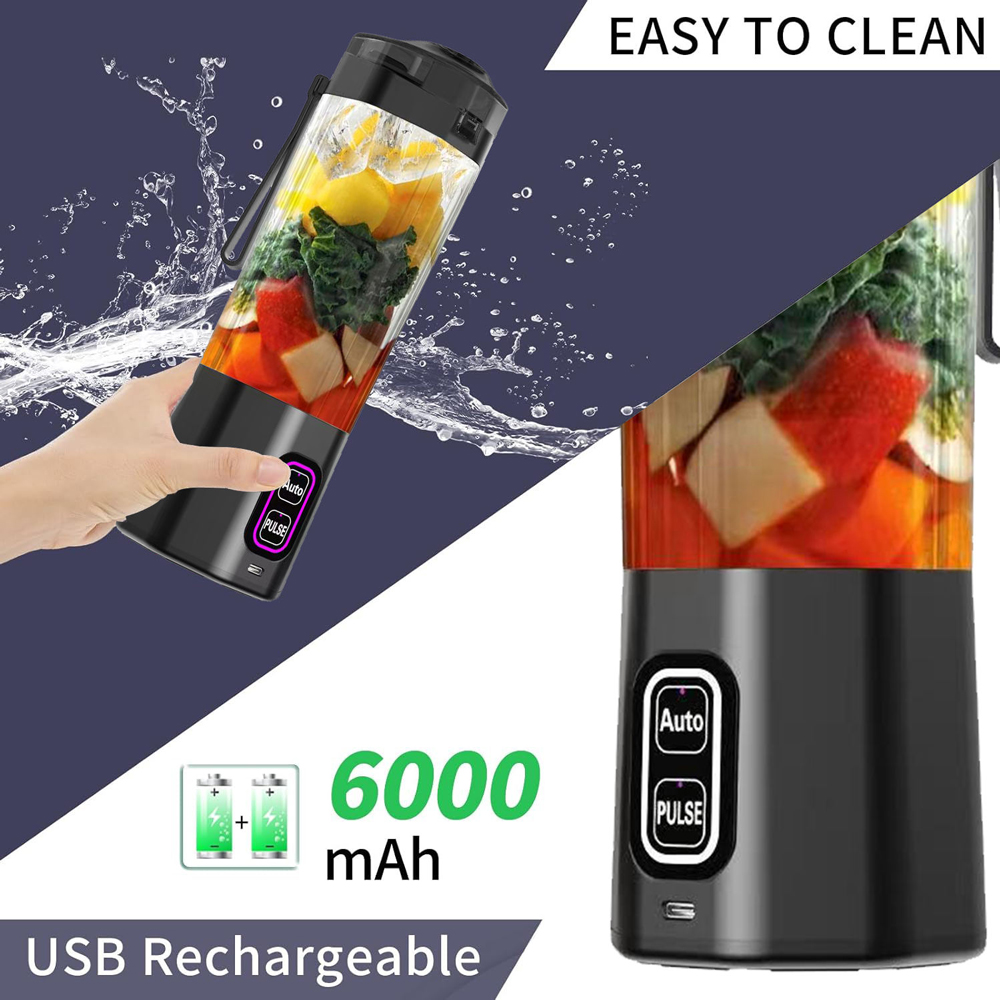
⑤ USB-C Charging and Lithium Battery Transport Compliance (UN3481)
Most portable blenders ship with an internal lithium-ion cell and a USB-C charge port, which pulls the product into air-freight battery regulation from the first carton. The applicable rule is UN3481 for lithium batteries contained in equipment, not the standalone UN3480 that applies to loose cells, and the distinction changes both your paperwork and your forwarder's acceptance criteria.
- Cell capacity is typically 1,500 to 2,000 mAh at 7.4 V, keeping per-unit energy under the 100 Wh air-freight threshold and avoiding the IATA Section II packaging surcharge that bites larger packs.
- A UN38.3 test summary and a 1.2 m drop test report are mandatory for the carrier; without them the forwarder will refuse the carton at origin and your container will sit.
- USB-C at 5 V / 2 A is the current norm; 9 V fast charge is avoided because it raises cell temperature and complicates the thermal-fuse specification.
- Marking must show the lithium battery handling label and a UN3481 reference on the master carton, or customs may hold the lot pending clarification.
⑥ Lid Seal Rings and Detachable Anti-Mold Design
The lid is where hygiene complaints originate, and a fixed, non-removable seal traps pulp at the thread and grows mold within two weeks of daily use in humid climates. The design decision here is detachability, not the ring material alone.
- Specify a detachable food-grade silicone ring at Shore A 40 to 50 that pops out for washing; document the pull-force tolerance, typically 3 to 5 N to remove and 8 to 12 N to reseat without loss.
- Add a vent valve with a separate silicone flap so pressure release routes away from the drinking spout and does not drip back through the lid.
- Claim an anti-mold property only when the ring carries a verified antimicrobial additive such as silver-ion at 0.8 to 1.2% loading, supported by ISO 22196 test data.
A detachable silicone seal ring with a separate vent flap is the design that survives a 60-day humid-shelf mock test without visible colonization in QA sampling.
⑦ Drop Test Results and Return-Rate Benchmarks
Field data from three 2025 container shipments, combined at 14,200 units, gives realistic benchmarks importers can build directly into supplier scorecards rather than guessing from brochure claims.
- Tritan cup with magnetic coupling: 1.1 m drop onto concrete, 92% survival across 6 faces; blended return rate of 2.3%.
- PP cup with direct-drive shaft: 1.0 m drop, 78% survival; blended return rate of 5.8%, with 61% of returns citing a leaking base.
- Glass-cup SKU: 0.8 m drop, 41% survival; returned at 11.4% even before warranty claims accrued.
- Units passing a 1.2 m six-face drop protocol showed a 38% lower Amazon return rate than units validated only at 0.8 m in the factory.
The correlation between drop-survival margin and return rate is the strongest single signal in the category, stronger than motor wattage or the brand label, and the metric we weight most heavily in audits.
⑧ Retail Color Box Dimensions and Pallet Stacking
Carton and pallet math decides whether a profitable ex-works price survives all the way to the shelf, and the juice-cup shape is awkward enough that small box changes move landed cost. A typical single-unit color box runs 95 by 95 by 230 mm with a 15 mm E-flute and prints at 350 gsm CCNB.
- Master carton: 12 units, 400 by 300 by 250 mm, gross weight 9.8 to 11.4 kg depending on cell size and cup material.
- 20 ft container: about 4,200 units, 350 cartons, 22 pallets; 40 ft HQ: about 10,800 units, 900 cartons, 54 pallets.
- Stacking height limit: 6 cartons, 1.5 m, for PP-cup masters; 8 cartons, 2.0 m, for Tritan given the higher crush resistance of the inner tray.
- Print a vertical this-side-up arrow and a max-stack line on the master; missing orientation marks added 0.7% transit-damage claims in our shipment data.
FAQ
What IP rating should I require for a tap-rinsed blender base?
For a base that is rinsed under a running tap, specify IPX6 minimum with a documented 500-cycle wash test. IPX5 is only adequate for wipe-down units, and claiming IPX7 without the double-lipped seal invites warranty claims you will end up paying for.
Is magnetic coupling worth the 15% cost premium?
For brands selling into markets with strict return policies or Amazon FBA, yes. The eliminated shaft seal removes the leading leak path and typically pays back the premium within the first return season through reduced liquid-damage complaints and fewer one-star reviews.
Do I need UN3481 documentation for sea freight?
Yes. Even for ocean containers, carriers and terminal handlers require the UN38.3 test summary and the lithium battery handling mark on the master carton. Sea freight does not exempt you from UN3481; it only changes the packaging class and the placard needed at the terminal.
Which cup material gives the lowest return rate?
Tritan with magnetic coupling posted a 2.3% blended return rate versus 5.8% for PP with direct-drive shaft in our 2025 shipments. Glass, while premium in feel, returned at 11.4% due to breakage and is rarely worth the risk for portable SKUs shipped in volume.
How should I grade ice-crushing claims for my listing?
Use the three-tier model: Tier A, crushed-ice certified, 6-wing 304 blade, 21,000 rpm, sub-4 mm in 30 seconds over 50 cycles; Tier B, soft-fruit only; Tier C, not ice rated. Match the claim to the tested blade so your listing accuracy survives a competitor or platform audit.