

 +86 15268683708



News
0102030405
Coffee and pepper grinders
How to Evaluate a Portable Blender Supplier: A 7-Step QC Guide for Importers
2026-10-09
Written for importers, distributors and private-label brands · By Blossom Product & Quality Team · Reviewed October 9, 2026
Choosing a portable blender supplier should not begin with unit price. It should begin with evidence: a traceable model, a market-specific document pack, repeatable sample tests, written change control and a pre-shipment inspection plan.
For importers, distributors and private-label brands, the fastest reliable process is to:
- define the intended market and use case;
- compare the exact model and bill of materials;
- verify safety, food-contact and battery documents;
- run repeatable sample tests;
- freeze the approved sample;
- inspect the production lot; and
- keep records that connect the shipped goods to the approved specification.
The key purchasing rule: approve evidence for the exact SKU and configuration you will buy. A certificate, waterproof claim or battery report for a similar model is not a substitute.
Why Should Buyers Evaluate Portable Blender Suppliers Beyond Price?
A rechargeable blender combines rotating blades, a motor, a food-contact vessel, seals, controls and a lithium battery in one compact product. A weakness in any of these systems can become a return, marketplace complaint, shipment delay or safety event.
A public recall illustrates the commercial exposure. On December 28, 2023, a recall notice for about 4.8 million BlendJet 2 portable blenders reported approximately 329 blade-break incidents, 17 overheating or fire reports, about 49 minor-burn reports and one laceration injury. The stated hazards were overheating or fire and blades breaking during use.1
This is not evidence about every portable blender or supplier. It is a real field-data case showing why buyers should treat blade integrity, temperature protection, battery control and model traceability as purchasing requirements.
| Public field data | Reported figure | Procurement implication |
|---|---|---|
| Units recalled | About 4.8 million | A design or component issue can scale across multiple retail channels. |
| Blade-break reports | Approximately 329 | Specify blade material, assembly method and change-control requirements. |
| Overheating or fire reports | 17 | Review the battery, protection circuit, charging input and abnormal-operation evidence. |
| Minor-burn reports | About 49 | Include temperature and charging observations in sample and lot checks. |
| Laceration injuries | 1 | Verify interlocks, blade access and instructions for the exact SKU. |
Buyer takeaway: a low sample price cannot compensate for missing traceability or weak change control. Ask not only “Does the sample work?” but “Can the supplier reproduce the approved design across the order?”
Step 1: Define the Product and Market Before Requesting a Quote
A useful request for quotation gives every candidate supplier the same brief. Without a fixed brief, quotations may refer to different batteries, motors, cups, accessories or packaging.
- destination country or countries;
- sales channel: retail, marketplace, promotional, outdoor or specialty;
- intended ingredients and use scenarios;
- target cup capacity and product weight;
- expected charging input and cable configuration;
- required colors, logo and packaging languages;
- forecast order quantity and replenishment pattern;
- required documents and destination-market tests;
- sample acceptance tests;
- planned launch date; and
- whether the design must support private-label or OEM changes.
For example, Blossom’s published range includes a 350 ml rechargeable model and a larger 650 ml HD-12 outdoor model. The models serve different briefs rather than being interchangeable.23
| Published specification | 350 ml rechargeable model | HD-12 outdoor model | What the buyer should verify |
|---|---|---|---|
| Capacity | 350 ml | 650 ml | Measured usable capacity and fill marking |
| Battery | 1,400 mAh | 6,000 mAh, 12 V | Cell and pack identity, charging time and test summary |
| Published speed | 26,000 rpm no-load / 20,000 rpm loaded | 26,000 rpm no-load / 20,000 rpm loaded | Test setup, ingredient load and repeatability |
| Published power | Not stated on fetched page | Maximum 370 W | Rated-input labeling and applicable evidence |
| Main positioning | Compact daily/travel use | Outdoor, pulse and dry-grinding use | Whether the use claim matches instructions and accessories |
| Published water claim | IPX7 design | IP7 | Exact test basis and permitted cleaning method |
The table compares manufacturer-published specifications, not independent laboratory results. Request model-specific evidence before reproducing a claim on packaging or listings.
Step 2: Verify the Exact Model, BOM and Change-Control Process
Put the following identifiers on the quotation, sample record and approval sheet:
- model number and product revision;
- motor model;
- battery cell and pack model;
- protection-board version;
- blade material and blade-assembly method;
- cup, lid and seal materials;
- charger or cable specification;
- firmware or control-board version, if applicable;
- accessory list; and
- packaging revision.
Define which changes require written approval. The supplier should not replace the cell, motor, blade, plastic resin, seal, control board or charger without notifying the buyer and repeating affected checks.
Golden sample rule: sign or uniquely identify the approved sample, photograph key components and store its specification with the purchase order.
Step 3: Review Safety, Food-Contact and Battery Evidence
The document pack depends on the destination market and final product configuration. Do not assume that one document makes the product compliant everywhere.
Check appliance-safety scope
IEC 60335-2-14:2025 covers the safety of household and similar electric kitchen machines, including blenders and battery-operated appliances with rated voltage not exceeding 250 V.4 Ask which standards and national deviations apply to your exact product and market.
- access to moving parts;
- interlocks and unintended operation;
- abnormal operation or stalled motor conditions;
- leakage and spillage;
- mechanical strength;
- markings and instructions; and
- charging-related risks.
Check food-contact materials
Request a material declaration and supporting test report for the cup, lid, seal, blade, blade holder and any internal coating. Match material names and colors to the production specification. For EU-bound programs, the European Commission provides food-contact-material guidance.5
Check the rechargeable battery and transport file
Connect the battery evidence to the exact cell and pack used in the product. Request:
- cell and pack manufacturer;
- model and rated capacity;
- safety data sheet where applicable;
- protection-circuit specification;
- applicable safety report;
- UN 38.3 test summary for transport where required; and
- shipment and packaging instructions.
A generic report bearing a different model number is a gap, not proof.
Step 4: Run Repeatable Sample Tests Instead of a One-Time Demonstration
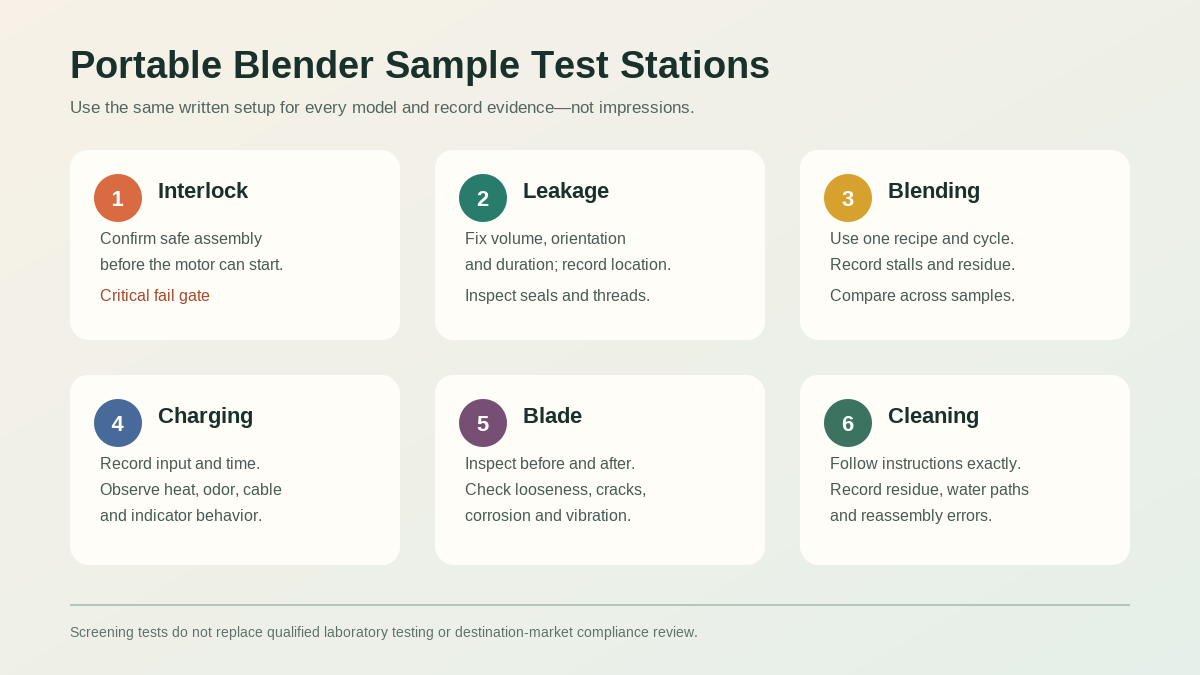
Use at least three samples for an initial comparison when practical. Record model, revision, lot identifier, battery status, ingredient mass, liquid volume, cycle length, ambient conditions, operator and result. This screening choice does not replace certification or statistically designed reliability testing.
Test A: Interlock and unintended-start check
- Confirm that the unit is charged and empty.
- Attempt normal operation with correct assembly.
- Misalign or remove the cup only in ways permitted by the evaluation procedure.
- Confirm whether the motor remains disabled.
- Repeat after reassembly.
Fail the sample if it starts while the blade is accessible or the required assembly condition is not met.
Test B: Leakage and seal check
- Inspect the seal, threads and mating surfaces.
- Add the agreed liquid volume below the marked maximum line.
- Close the lid using the normal user action.
- Hold the unit in defined orientations over absorbent paper.
- Run the agreed blending cycle.
- Record leakage location and mass loss, if measured.
Set the acceptance threshold in the purchase specification. “Leakproof” without a position, duration and pass criterion cannot be audited.
Test C: Blending consistency check
Use the same ingredient recipe and preparation for every sample. Record:
- ingredient type and mass;
- ice size or frozen-fruit size, if allowed;
- liquid volume and temperature;
- number and duration of cycles;
- stall or restart events;
- remaining visible pieces; and
- final product temperature.
Do not create a universal “ice-crushing” threshold if the instructions do not support that use.
Test D: Charging and surface-temperature observation
Record the cable or charging device, input rating, starting charge state, duration and status indication. Observe for abnormal odor, deformation, discoloration, intermittent connection or unexpected heat. Formal compliance testing belongs with a qualified laboratory.
Test E: Blade and assembly inspection
Before and after repeated cycles, inspect:
- blade deformation or looseness;
- fastener movement;
- contact marks;
- cracks around the blade holder;
- corrosion or residue; and
- changes in noise or vibration.
Test F: Cleaning and reassembly check
Follow the supplier’s instructions exactly. Record cleaning time, inaccessible residue, water near charging or motor areas, seal displacement and reassembly errors.
Do not write “dishwasher-safe,” “fully waterproof” or “zero risk” unless exact-model evidence and instructions support that wording.
Step 5: Score the Supplier and Apply Critical-Fail Gates
A weighted score helps compare candidates, but a critical safety or document gap should override the total.
| Evaluation area | Suggested weight | Example evidence |
|---|---|---|
| Product and channel fit | 15% | Capacity, use case, accessories and target retail price |
| Functional consistency | 20% | Repeatable recipe results across samples |
| Safety design | 20% | Interlock, blade access and abnormal-operation evidence |
| Battery and charging file | 15% | Traceable cell/pack, charging specification and transport file |
| Food-contact and market documents | 15% | Material declaration and model-matched reports |
| Manufacturing control | 10% | BOM control, in-process checks and change approval |
| Communication and corrective action | 5% | Clear records, response quality and closure of sample issues |
Critical-fail examples:
- unsafe start condition;
- blade loosening or structural damage;
- uncontrolled overheating, smoke or deformation;
- model mismatch in key reports;
- undisclosed component substitution;
- persistent leakage into an electrical area; or
- missing traceability for the battery or production lot.
Step 6: Convert the Approved Sample into a Production Control Plan
Before mass production, agree on:
- final specification and signed sample;
- incoming checks for cells, blades, plastics and seals;
- in-process tests and frequency;
- end-of-line functional checks;
- charging and indicator checks;
- leakage sampling;
- appearance and packaging standards;
- lot and date-code format;
- nonconformance handling; and
- approval process for rework or substitution.
Blossom states that its quality flow covers raw-material, semi-finished-product, production and assembly-line inspection. Buyers should convert that general process into model-specific checkpoints and records.
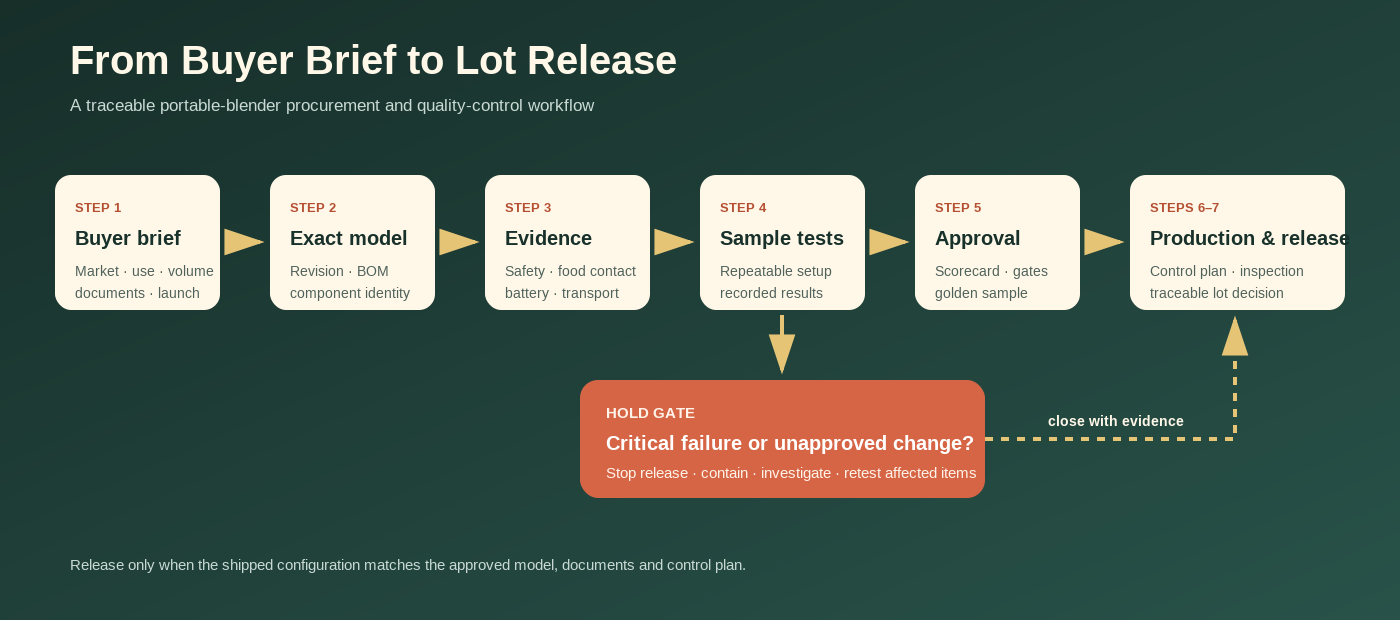
Step 7: Perform Pre-Shipment Inspection Against the Frozen Specification
The pre-shipment inspection should answer three questions:
- Is the production lot the same configuration that was approved?
- Does the sampled product meet the defined workmanship, function and packaging criteria?
- Are the lot records and shipment documents complete?
Check carton marks, quantities, model and rating labels, accessories, manuals, barcode data, packaging languages and traceability codes. Repeat selected functional, leakage, charging and interlock checks according to the agreed sampling plan.
If a component changed, pause release and assess which tests and documents must be repeated. Do not accept a verbal statement that the replacement is “equivalent.”
A Real Procurement-Risk Case: What the 2023 Recall Teaches Buyers
The public BlendJet 2 case reached mass retail before the recall. Units were sold through major retailers and online from October 2020 through November 2023.1 The lesson is to build controls that can detect and contain risk:
- keep serial or lot traceability;
- make blade and battery changes approval-controlled;
- preserve complaint data by failure mode;
- define escalation thresholds;
- retain test and inspection records; and
- prepare a corrective-action and field-response process before launch.
Why Buyers Work with Blossom on Portable Blender Programs
Blossom offers portable blender formats for different channels, including a compact 350 ml rechargeable unit and the larger HD-12 outdoor model. The company also publishes OEM-oriented capabilities including logo and packaging customization and a four-stage quality-control process.
A productive inquiry should include the destination market, sales channel, expected ingredients, capacity, quantity, target launch date and required documentation. Blossom can then recommend an exact model for sample evaluation.
Need a Model-Matched Portable Blender Sample?
Send Blossom your destination market, sales channel, target capacity, ingredients, quantity and required documents. The team will recommend an exact model and prepare a focused sample and quotation package.
Request a Portable Blender Sample
Also review:
- Portable Blender Product Range
- Portable Blender Safety and Cleaning Features Buyers Should Check
- Small Appliance Sample Evaluation Scorecard
- Import Compliance and Labeling Strategy
Portable Blender Buyer FAQ
What should I ask a portable blender supplier before requesting samples?
Send the destination market, intended use, ingredients, cup capacity, battery and charging requirements, packaging languages, forecast quantity, required documents and written sample-test criteria. Ask the supplier to quote an exact model and revision.
How many samples should an importer test?
For an initial comparison, three units per candidate can reveal obvious inconsistency better than one demonstration unit. Reliability validation or lot acceptance sample sizes depend on risk, order size and the inspection plan.
Which document is most important for a rechargeable portable blender?
There is no single universal document. Buyers typically need model-matched appliance-safety evidence, food-contact documentation and battery or transport records appropriate to the destination market.
How can I verify a waterproof claim?
Ask for the exact rating, test method, laboratory report, sample identity and permitted cleaning instructions. Confirm that the tested construction matches the unit you will order.
What is the difference between OEM and private label for portable blenders?
Private label often means applying branding and packaging to an existing platform. OEM may involve changes to color, accessories, materials, controls or tooling. Changes affecting safety, food contact, charging or structure may require renewed risk assessment and testing.
What should cause an immediate sample rejection?
Reject or quarantine a sample if it can run with an unsafe assembly, shows blade loosening, uncontrolled heating, smoke, deformation, electrical-area leakage or key document/model mismatch.
How should I compare two suppliers quoting different prices?
Normalize capacity, battery, motor, blade, materials, accessories, packaging, documents, warranty and inspection requirements before comparing landed cost and quality risk.
Can Blossom customize packaging and branding?
Blossom’s website states that logo and packaging customization are available. Confirm the exact MOQ, artwork requirements, lead time and model-specific options in the written quotation.
Final Buyer Checklist
Before placing the order, confirm that you have:
- an exact model and revision;
- a frozen BOM or controlled specification;
- model-matched safety, food-contact and battery evidence;
- completed sample records;
- a signed or uniquely identified golden sample;
- written change-control terms;
- a production control plan;
- a pre-shipment inspection plan; and
- lot-level traceability.
If any item is missing, resolve it before discussing a faster launch.