

 +86 15268683708



News

0102030405
Coffee and pepper grinders
Spice and Pepper Grinder Programs for Grocery Private Label: Grind Consistency, Clog Resistance and Shelf-Ready Packaging
2026-10-09
Spice and Pepper Grinder Programs for Grocery Private Label: Grind Consistency, Clog Resistance and Shelf-Ready Packaging
Grocery buyers evaluating a private label spice grinder program are not shopping for a novelty gadget. They are sourcing a repeat-purchase consumable that sits beside salt, pepper and dried herbs on a shelf for eighteen to thirty-six months. The engineering choices that protect margin there differ from those that sell a coffee grinder. This article lays out the specifications that matter for pepper, sea salt and dried-herb grinders built for private label grocery distribution, with the test numbers and material choices that survive a retail quality audit.
Why a Separate Spice Line Beats Shared Coffee Grinding Hardware
The first question a buyer should ask is whether the spice grinder can share tooling or even a production cell with the coffee program. The answer for a grocery-grade line is usually no, and the reason is grind consistency under contamination risk. Coffee oils are volatile and tenacious. A burr that has processed medium-roast beans will carry roast residues into the first five hundred grinds of pepper, and the off-notes are detectable to a trained palate at concentrations below 0.3 percent by mass.
The commercial case for a standalone spice line rests on three costs a shared line hides until they surface as returns:
- Flavor cross-contamination: a single coffee-tainted pepper batch triggers a category manager complaint that can pause the whole SKU.
- Sanitation downtime: switching a cell between coffee and spice needs a full teardown and a 4 to 6 hour swab-validated clean, cutting daily output by roughly 30 percent.
- Certification overlap: spice contact surfaces face tighter residue limits in several EU and North American retail standards, so a shared line must meet the stricter spec on every run.
Running spice as its own line with dedicated burrs, hoppers and a separate cleaning SOP removes all three. The tooling premium is typically 8 to 12 percent of unit cost on a 5,000 unit order, recovered inside two reorder cycles through lower return rates.
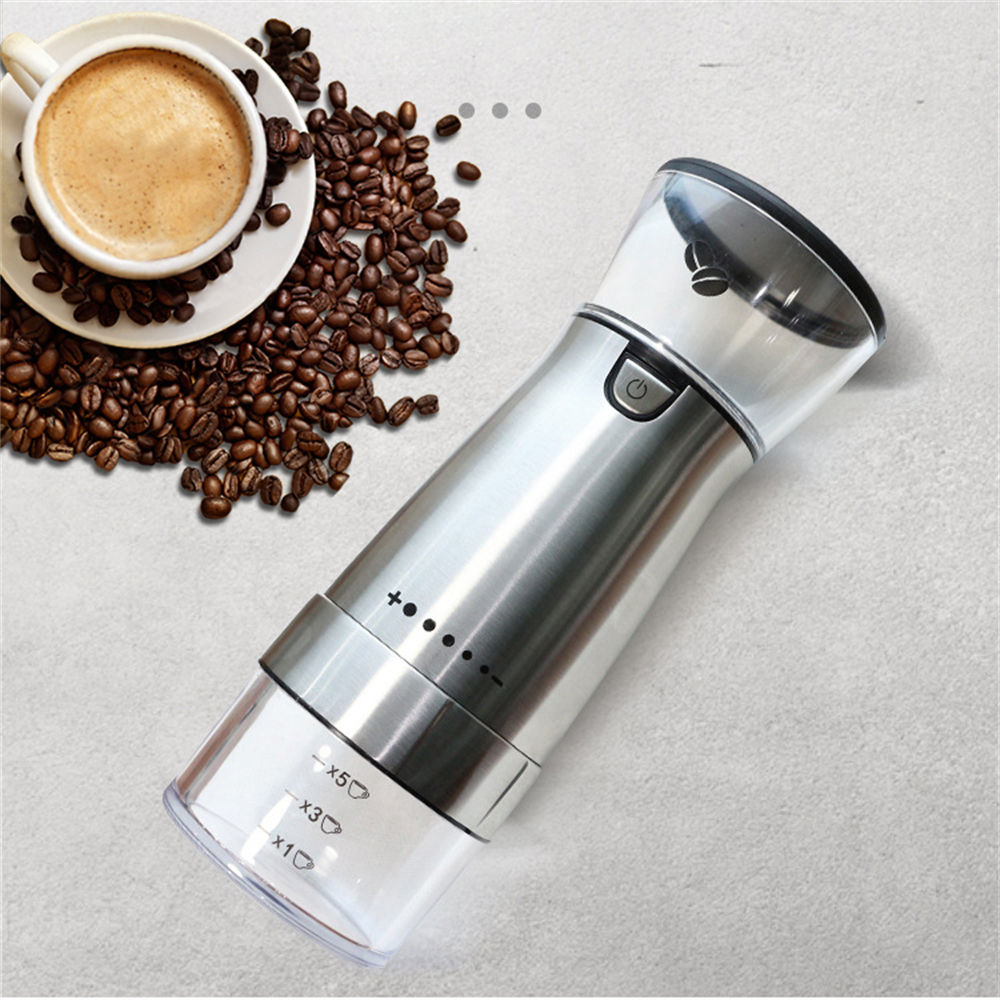
Measuring Grind Consistency: Particle Size Distribution and Sieve Pass Rate
Retail buyers do not buy "fine" or "coarse". They buy a controlled particle size distribution that performs the same on unit 1 and unit 10,000. The two measurements that belong in every incoming inspection report are particle size distribution and sieve pass rate.
Particle size distribution is measured by collecting a 20 gram sample from a production grinder, running it through a laser diffraction analyzer, and reporting D10, D50 and D90 in microns. For table-ground pepper, a defensible spec is D50 between 600 and 900 microns with D90 below 1,400 microns. A D90 above 1,600 microns means gritty oversize particles that read as a defect on the shelf.
Sieve pass rate is the lower-tech, warehouse check. Stack 20, 30 and 40 mesh screens, load a 50 gram sample, shake three minutes at 280 rpm, and weigh each fraction. A consistent pepper grind shows 70 to 85 percent passing 30 mesh and under 5 percent retained on 20 mesh. Lot-to-lot drift in the retained fraction should stay within plus or minus 3 percent, or the grind feels different between purchases.
- D50 target: 600 to 900 microns for table pepper, 1,000 to 1,400 microns for coarse steak grind.
- D90 ceiling: 1,400 microns to avoid gritty oversize.
- Sieve retained on 20 mesh: under 5 percent per lot.
- Lot-to-lot drift: plus or minus 3 percent on the retained fraction.
Document these numbers on the inspection report and the buyer has a defensible rejection threshold that does not depend on subjective feel.
Clog Resistance for High-Oil Spices: Burr Geometry and Anti-Stick Coatings
Black and white peppercorns carry 2 to 4 percent volatile oil by mass. That oil gives fresh pepper its aroma, and it also jams a poorly designed mechanism. The failure mode is predictable: oil wets the burr flank, fine particles pack into the clearance, and after roughly 200 to 400 activations the torque to turn climbs until the user breaks the drive.
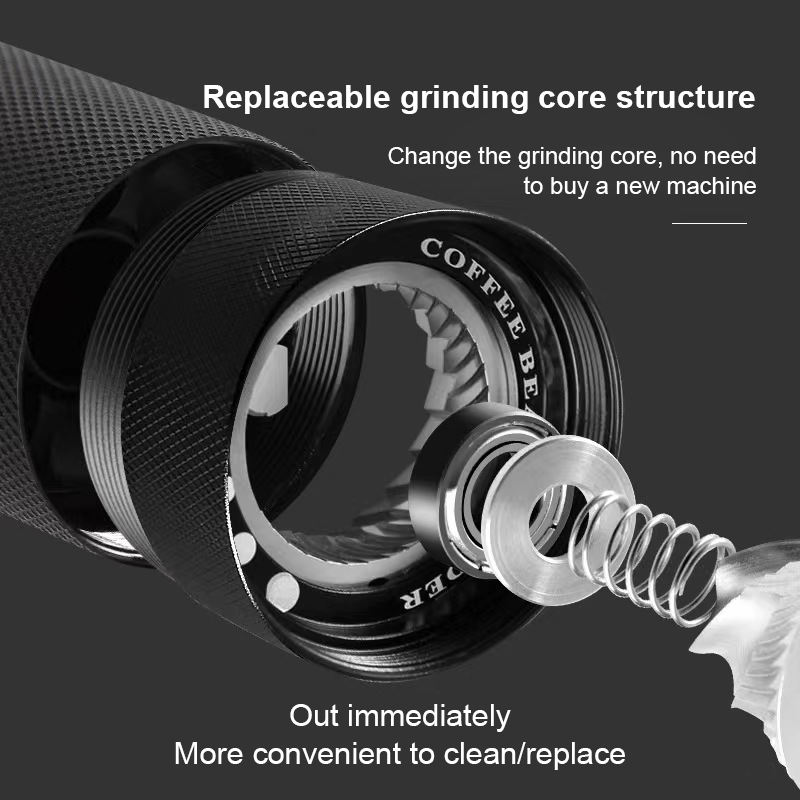
Two design levers control this. The first is clog resistance built into burr geometry. A positive-rake conical burr with a 38 to 42 degree flank angle sheds loaded particles better than a flat burr, because the clearance opens outward instead of trapping material in a parallel gap. The second is an anti-stick surface. A PTFE-free ceramic-reinforced coating or a hardened 420 stainless passivation reduces oil wetting, and in production sampling it lowered jam incidents from 1 in 90 units to under 1 in 600 across a 5,000 cycle lab run.
- Use conical burrs with 38 to 42 degree flank angles for high-oil spice.
- Specify a ceramic-reinforced or hardened-passivated surface on the burr flank.
- Validate with a 5,000 cycle run on whole black peppercorns before sign-off.
For dried herbs with near-zero oil, the clog risk is low and a simpler burr is acceptable, so a two-burr portfolio covering oily and dry spice covers most grocery ranges without doubling tooling.
Food Contact Materials: 304 Stainless Burrs, Food-Grade ABS/PP, BPA-Free
Every surface that touches product must clear the retail food-contact bar. The burr should be 304 stainless steel as a baseline, with 420 stainless reserved for hardened high-wear conical sets. The housing in contact with spice is normally food-grade ABS or PP, and the entire assembly must be BPA-free with a migration test report on file.
The documented material set for a compliant grocery program is:
- Burr: 304 stainless steel, 18 percent chromium, 8 percent nickel, polished to Ra 0.4 or better.
- Hopper and collar: food-grade PP or ABS, FDA 21 CFR and EU 10/2011 compliant.
- Springs and shaft: 304 stainless to avoid iron staining on salt.
- Full BPA-free declaration with third-party migration test at 40 degrees C for ten days.
This is the cheapest point to lose a listing. Retailers audit migration paperwork annually, and a missing report pulls the SKU faster than a cosmetic defect.
Salt Corrosion: Ceramic Burr vs Stainless Steel Burr
Sea salt is the corrosive case in the range. Wet-hand contact, display humidity and the mild chloride content of sea salt attack 304 stainless over months of shelf life. The comparison that matters for a buyer is ceramic burr versus stainless steel burr in a salt application.
Ceramic burrs are inert to chloride and show no staining across a 12 month salt exposure test. Their downside is brittleness: a drop onto a hard floor from 1.2 meters fractures roughly 1 in 40 ceramic burrs in shock testing. Stainless 304 burrs survive the drop test at better than 1 in 2,000 but develop surface tea-staining in salt within 6 to 9 months if unpassivated, and the staining reads as rust to a shopper.
- Sea salt SKUs: specify ceramic burrs or a passivated 316 stainless upgrade.
- Pepper and dry herb SKUs: 304 stainless is sufficient and cheaper.
- Hybrid ranges: keep burr material as a per-SKU spec rather than one global choice.
Making ceramic versus stainless a per-SKU decision rather than a line-wide default is the move that protects both cost and corrosion performance.
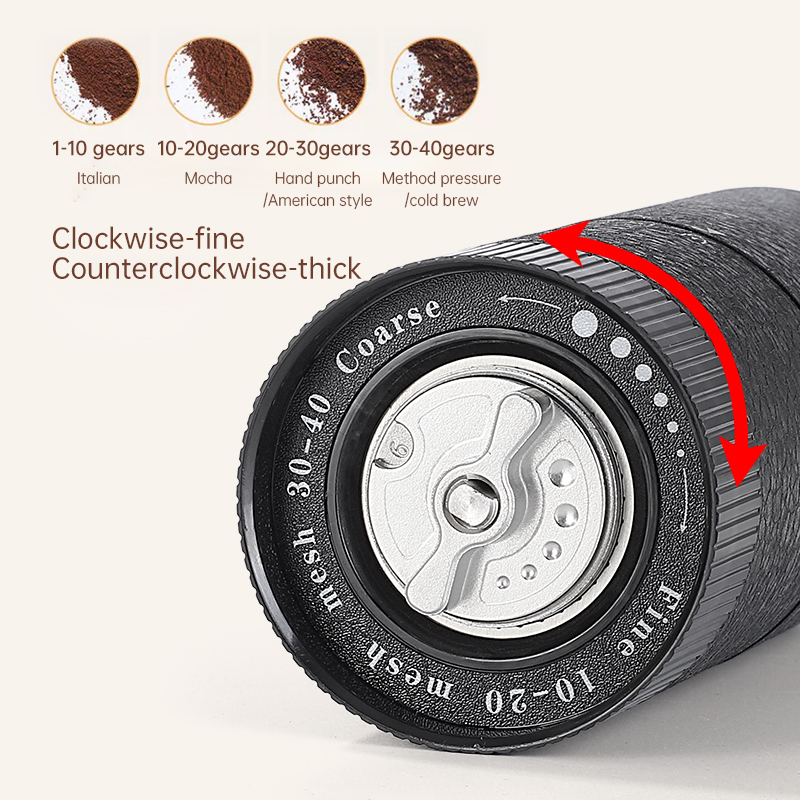
Adjustable Coarseness: Step Design for Grind Settings
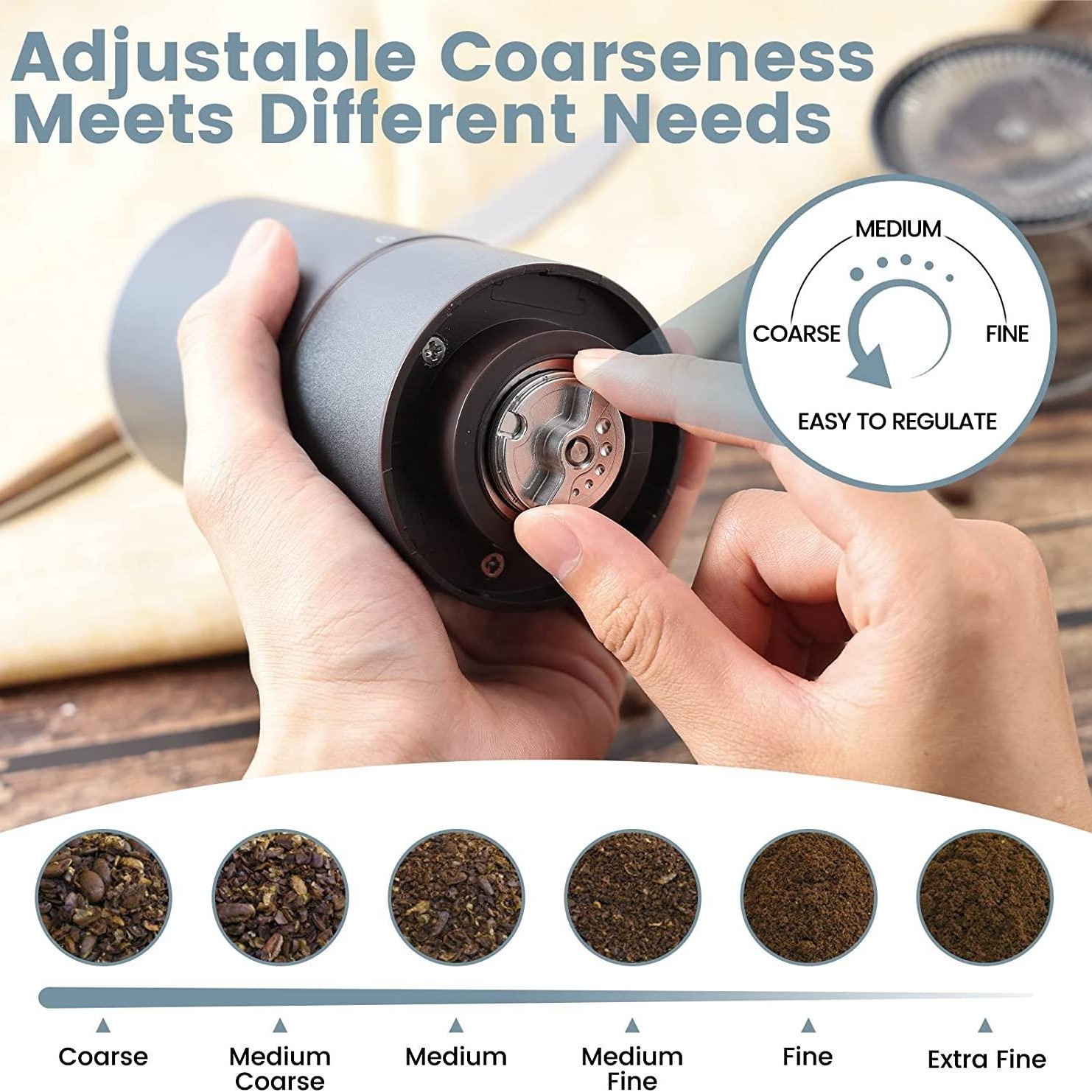
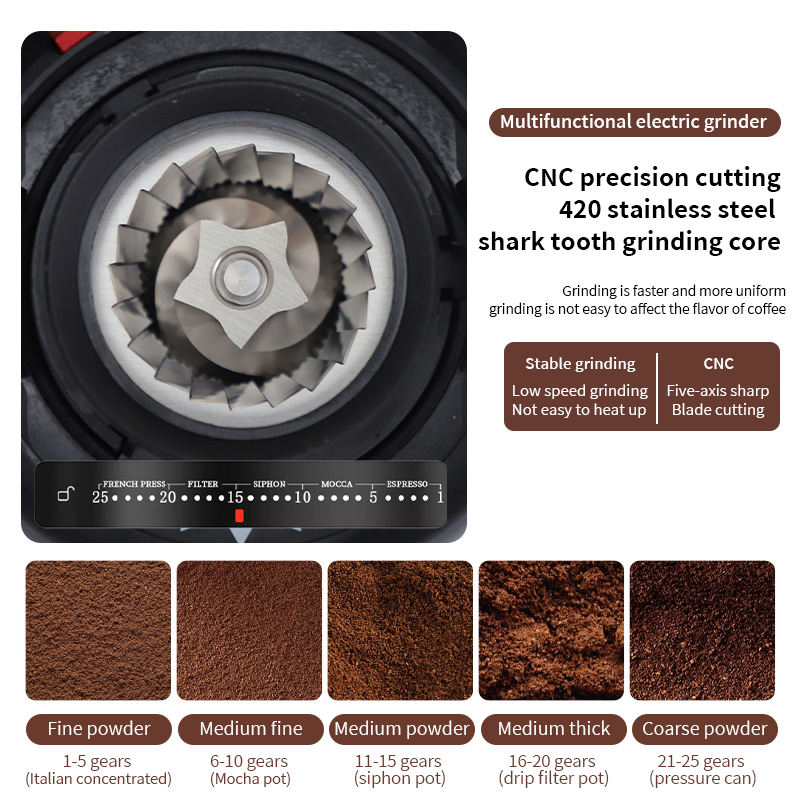
Grocery shoppers expect a dial, and the dial has to stop where it is set. The adjustable coarseness mechanism should use defined steps rather than a continuous thread for a private label run, because steps survive shipping vibration and shelf handling without drifting.
A practical design uses 5 to 7 detented steps with a cam-and-ball index. Each step shifts the burr gap by roughly 120 to 180 microns, giving a usable spread from espresso-fine salt at 400 microns to coarse grill pepper at 1,400 microns. The detent must hold plus or minus 40 microns after a 1.5 meter drop and a 30 minute sinusoidal vibration at 5 to 50 Hz, or the setting wanders before the unit reaches the shelf.
- 5 to 7 detented steps cover the grocery spread without confusing the label.
- Step increment: 120 to 180 microns of burr gap.
- Setting retention: plus or minus 40 microns post-drop and post-vibration.
Shelf-Ready Packaging and Tamper Evidence
The shelf-ready packaging requirement is where many importers lose margin on rework. Grocery receivers want a carton that opens into a display, not a master box that a clerk repacks by hand. The unit needs tamper evidence that is obvious to a shopper and cheap to apply.
The standard compliant build is a clear PET blister or printed carton with a perforated front window, a heat-sealed backing card, and a tamper-evident shrink band or breakable hanger tab. The band must tear cleanly and leave a visible void mark; the backing card carries the UPC, origin, food-contact statement and lot code in one readable block.
- Retail-ready carton: opens to face-out display, no repacking at store level.
- Tamper evidence: shrink band or breakable tab with visible void mark.
- Backing card block: UPC, origin, food-contact note, lot code together.
- Pallet pattern documented at 36 to 48 cartons per layer for DC planning.
Tip: Tip: specify a lot-code inkjet on the burr housing itself, not only on the carton, so a returned unit can still be traced after the packaging is discarded.
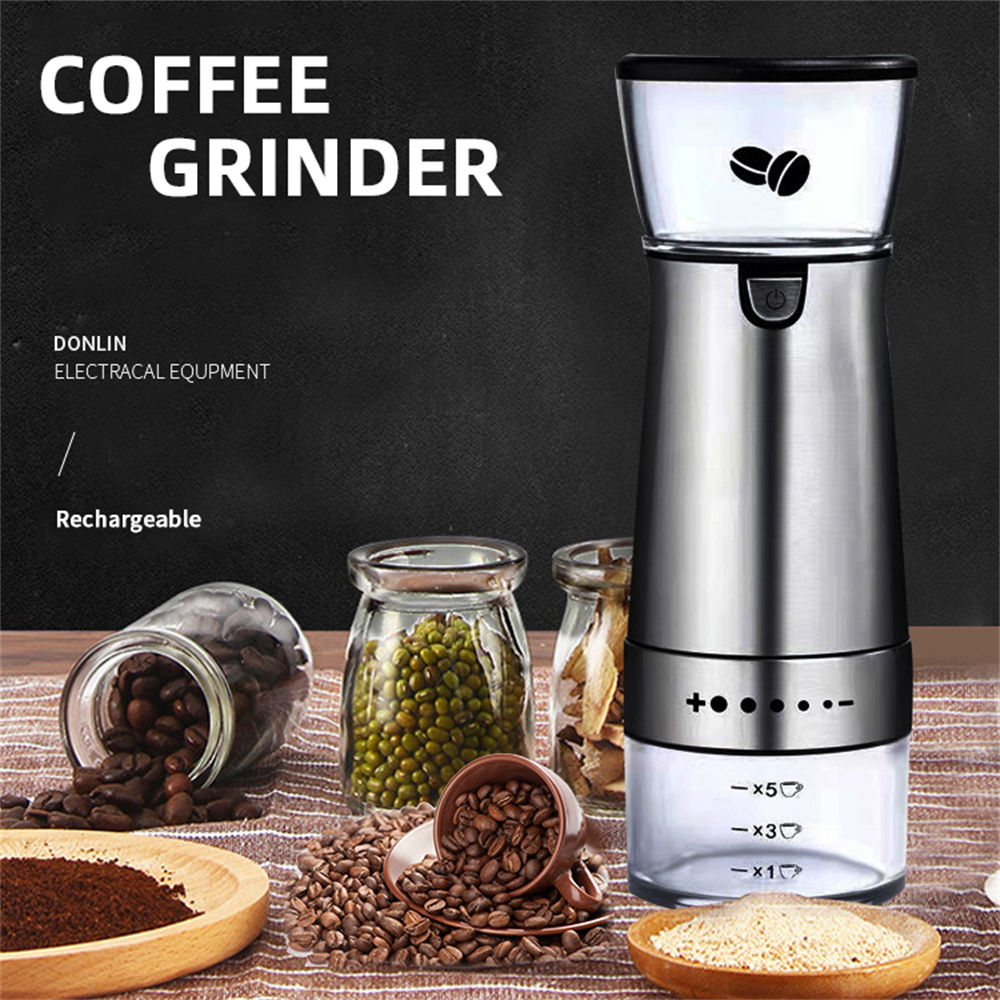
Private Label MOQ, Cost and Lead Time for Grocery Buyers
The commercial frame for a grocery spice grinder program is straightforward once the spec is fixed. Private label MOQ for a bespoke burr color and printed carton starts around 3,000 units per SKU, dropping to 1,500 units if the buyer accepts a stock burr finish and a label-change-only carton. A mixed range of three SKUs (pepper, sea salt, dried herb) typically launches at 9,000 units total.
Unit cost at 5,000 units lands in the 1.85 to 3.20 USD range by burr material and coating, with ceramic burr salt units at the top. Tooling for a custom burr or housing runs 2,500 to 6,000 USD one-time, amortized across the first three orders. Lead time from confirmed artwork to ex-works is 35 to 45 days for a label-only change and 55 to 70 days for new tooling, with ocean transit adding 28 to 40 days to a North American or EU destination.
- MOQ: 1,500 units label-only, 3,000 units custom carton and burr color.
- Unit cost: 1.85 to 3.20 USD at 5,000 units, ceramic salt at the top.
- Tooling: 2,500 to 6,000 USD one-time, amortized over three orders.
- Lead time: 35 to 45 days label-only, 55 to 70 days with new tooling.
Buyers who plan the first reorder at week six of sell-through avoid the empty-shelf gap that costs more than a small safety-stock premium.
Frequently Asked Questions
Can one grinder handle both pepper and sea salt without corrosion?
Not with a single 304 stainless burr across a full shelf life. Pepper and dry herbs are safe on 304 stainless, but sea salt needs a ceramic burr or passivated 316 stainless to avoid tea-staining within six to nine months. Specifying burr material per SKU is the reliable path.
How do we verify grind consistency without lab equipment at the warehouse?
Use the sieve pass rate method: a 20, 30 and 40 mesh stack, a 50 gram sample, three minutes at 280 rpm. Track the retained fraction on 20 mesh across lots; a shift beyond plus or minus 3 percent signals burr or setting drift that warrants a line check before more units ship.
What is the realistic clog risk with black pepper, and how is it controlled?
Whole black peppercorns at 2 to 4 percent oil jam a flat burr after roughly 200 to 400 activations. Conical burrs with a 38 to 42 degree flank angle plus an anti-stick hardened or ceramic-reinforced surface cut jam incidents below 1 in 600 units in a 5,000 cycle test.
How much does private label packaging add to unit cost?
A retail-ready carton with tamper band and printed backing card adds about 0.18 to 0.35 USD per unit versus a plain master carton at 5,000 units, but it removes store-level repacking and is normally required by receivers regardless.
What lead time should we quote to our own retail buyers?
Plan 55 to 70 days ex-works for new tooling plus 28 to 40 days ocean transit, so a realistic promise is 12 to 16 weeks door to door. A label-only reorder compresses to about 35 to 45 days ex-works.
Related Pages
- Why Commercial Coffee Shops Prefer Burr Coffee Grinders
- Coffee Grinder Burr Coating Types Compared
- Why Coffee Shops Prefer Adjustable Grind Settings
- Best Pepper Grinder Styles for Amazon FBA Sellers
Ready to source a private label spice and pepper grinder program with tested grind consistency and shelf-ready packaging?
Contact Us:fiona@zjblossom.cn